
1.1 Current Sport Landscape
Module 1: The Sport Landscape & Coaching Culture
In this module we look honestly at the current state of youth sport: why participation is declining, what it is doing to the athletes we work with, and what our role as coaches means in that context. We then turn that awareness into action by examining what it means to build a genuine coaching culture grounded in clear values, real goals, and a deep understanding of what every stakeholder actually needs.
By the end of this module you will: understand the forces shaping the sport landscape today, be able to articulate your own coaching values, and know what players, parents, and your organization need from you this season.
1.1 Where are all the athletes going?
Insert course introduction video here. Suggested length: 3-5 minutes. Topics: who this course is for, what is at stake in youth sport today, and why coaching matters more than most people realize.
A significant percent of children abandon organized sport by the age of thirteen. The average child's involvement in sport is just six years. That is not a sport problem, it is a systemic one and it means that the majority of children who start playing will stop before they have experienced anything close to the best sport has to offer.
Understanding why this is happening is not just interesting background information. It is the reason this course exists. As a coach, you are one of the most powerful forces in whether a child's experience of sport is worth staying for.
The top ten factors contributing to the decrease of participation include the following.
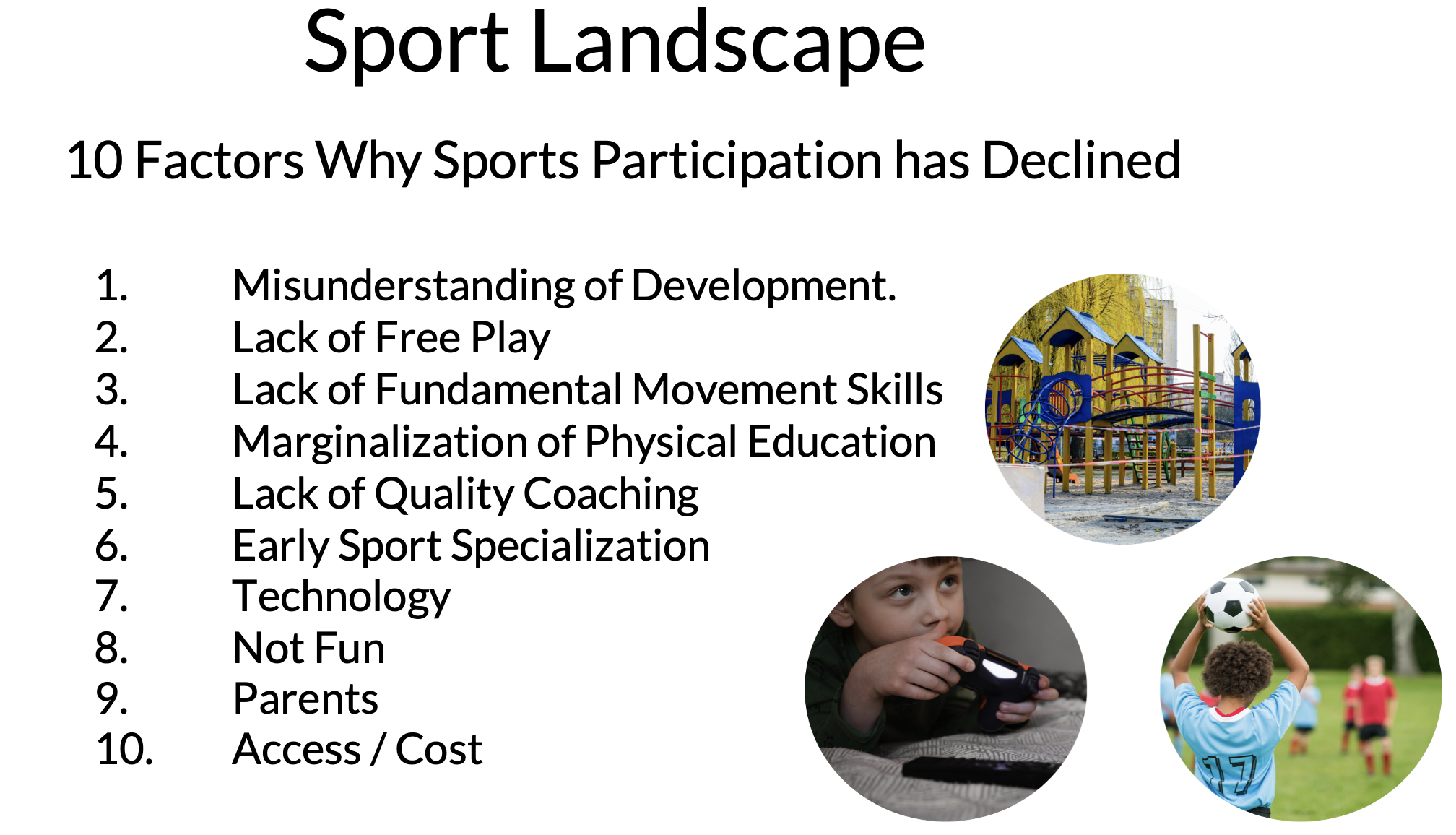
- Development means 'finishing the season better than one started across a mutually agreed upon set of criteria'. Where that is not baselined and re-evaluated, stakeholders often defer to the standing, score and schedule as 'development', when that is not the truth.
- Free play, which is unstructured play that usually occurs during the ages of 0-5, is crucial for developing physical skills as well as decision-making abilities and connecting synapses in the brain.
- Fundamental movement skills are core movement skills such as running, catching, jumping, throwing, kicking, dodging and rolling. These skills are not only important for physical development but also for life.
- Physical education is often marginalized in schools, with a high percentage of elementary and secondary schools not having a specialist physical education teacher leading classes.
- Lack of quality coaching has led to the mistrust of coaches by players & parents. In order for that trust to be restored we must find an appropriate balance between the win-at-all-cost and the no-idea-how-to-lead coach.
- Another issue is that the fun factor of youth sports has significantly decreased, with the adultification of youth sports and the rise of technology providing alternative options for kids.
- Technology has also been identified as a significant factor, with the advent of technology in 2007 leading to a decrease in the desire to participate in sports.
- Early sport specialization has been found to have adverse effects on performance. Boredom, fatigue, and burnout are cited as the leading byproducts of early sport specialization, while numerous studies show the benefits of participating in multiple sports.
- Poor parent behaviour and expectations in youth sports can lead to pressure to win at all costs, verbal and emotional abuse, over involvement, and unrealistic expectations, creating a toxic and unhealthy environment for children that can negatively impact their physical and mental health and enjoyment of the sport.
- Access to youth sports programs can be limited in some areas, particularly in low-income or rural communities. Some neighbourhoods may lack adequate sports facilities, while others may not have enough trained coaches or volunteers to run programs. The rising cost of youth sports is another problem, creating a widening gap between those who can and cannot afford to participate. This leads to situations where the best players may not be showing up to participate as much as those who can afford it.
As a coach, it’s essential to understand how these factors will impact the group of players that you’re leading. By creating environments that support free play and discovery, mastering fundamental movement skills, and weaving in quality daily physical education, we can strive to make a difference in the current sport landscape.
By being mindful of costs and harnessing the power of technology while encouraging kids to sample multiple sports during their development years, and most importantly, making their sporting experiences fun, we can work towards retaining more young players in sports.

0 comments